
August 21, 2026
Your Forgiveness Count Changed
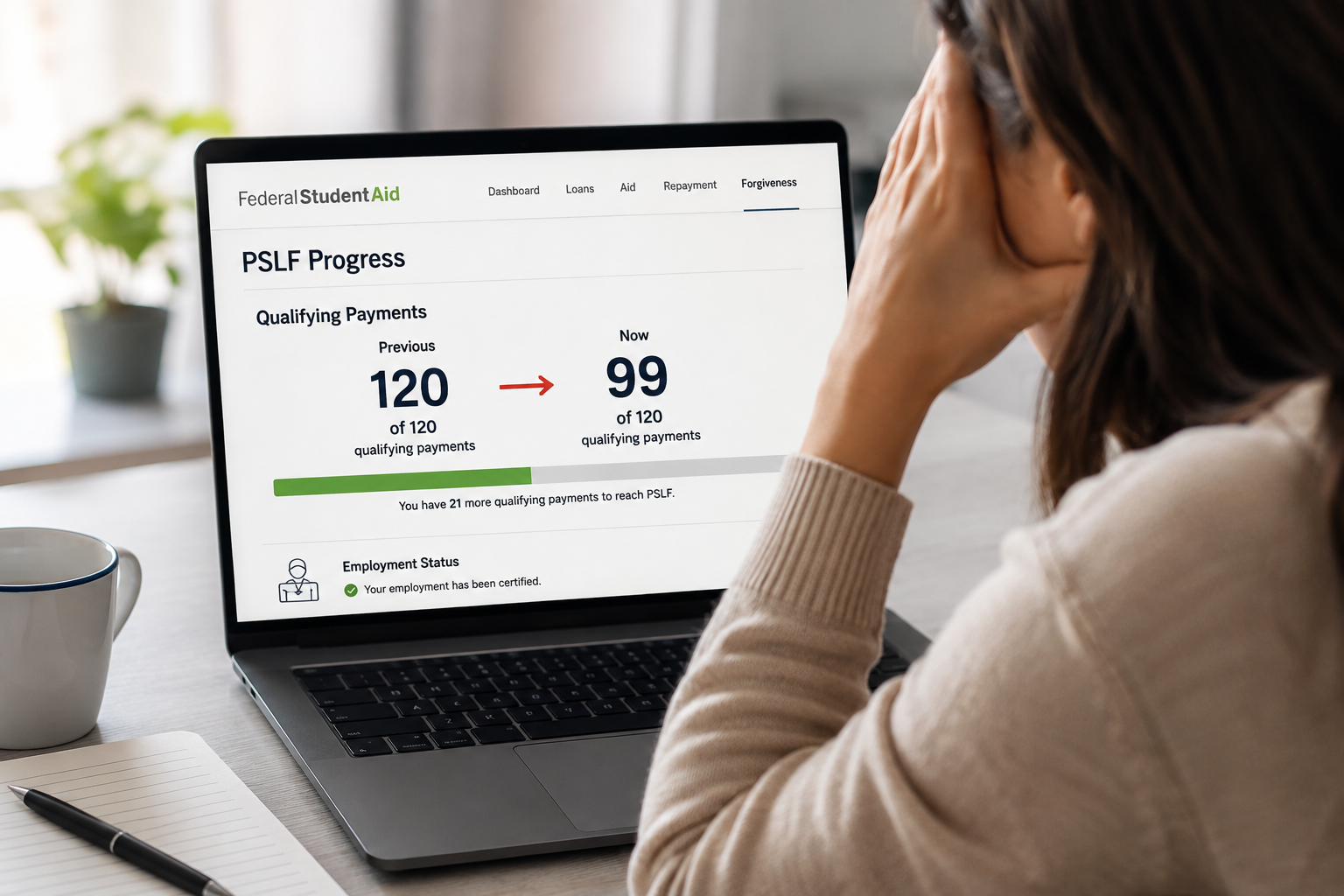
There are few worse feelings than logging in to check your progress toward forgiveness and finding a smaller number than the one you remember.
That happened to a lot of borrowers in early August. People who had been at 103 qualifying months saw 88. People sitting on 120 — done, finished, waiting — saw 99. Several noticed the drop right after submitting an employment certification, which made it feel like the act of doing everything right had somehow cost them.
If that’s you, here’s what we actually know, what’s still unclear, and what to do about it.
Saw your count change? Schedule a complimentary consultation — we’ll figure out what’s actually going on with your file.
This article is general information, not legal or financial advice for your particular situation. Federal student loan policy is moving quickly; the details here are accurate as of August 18, 2026.
What happened, in order
- Early August: Borrowers began reporting sudden drops in their PSLF qualifying month counts on StudentAid.gov
- August 6–7: A banner appeared on StudentAid.gov stating that the number of PSLF qualifying months of employment was incorrect and that the data issue was being worked on. Call center staff told borrowers their payments still qualified and a fix was coming. Most reporting at that point treated it as a display glitch.
- August 17: The Department of Education described it differently. It said that while updating federal student aid systems for the July 1 changes, Federal Student Aid identified multiple PSLF counter code errors stemming from changes implemented in May 2024 — and that some credit granted under earlier temporary initiatives, including the Limited PSLF Waiver and the One-Time IDR Account Adjustment, was being rolled back on purpose.
So — panic, or don’t panic?
Neither, honestly. Here’s how we’d frame it. A smaller number on a dashboard is not the same as lost progress. The count you see is a display generated from underlying records — your actual payment history, your loan types, your certified employment. Those records exist independently of what the tracker shows this week. Counts have been recalculated, broken, restored, and recalculated again multiple times over the past few years. Reacting to the number in isolation is how people make expensive decisions, like abandoning PSLF a year from the finish line or consolidating in a way that can’t be undone. But this also isn’t something to wait out passively. The Department’s own framing shifted in eleven days from “this is incorrect and we’re fixing it” to “some of this was intentional.” When the rules of a rollback aren’t public and the scope isn’t disclosed, the borrowers who come out whole are the ones who can prove what they had. That’s the whole strategy: don’t panic, don’t wait, document.Do these five things this week
- Screenshot everything, today. Your PSLF tracker. Your qualifying month count. Your loan detail pages. Whatever the numbers say right now, capture them with the date visible. If they change again, you’ll have a before and after.
- Download your full payment history — from both places. Pull it from StudentAid.gov and from your servicer’s portal. They’re separate systems and they don’t always agree, which is exactly why you want both. Save them as files, not bookmarks.
- Gather every approved employment certification. Every PSLF form you’ve submitted and every approval letter you’ve received. This is the single most valuable category of documentation you have, because employment months are what a payment gets matched to.
- Check your Aid Summary. The IDR payment count tracker has been unavailable on StudentAid.gov for more than a year. While it’s down, the Aid Summary page still shows per-loan qualifying month information in plain text. It’s not pretty, but it’s a data point worth capturing.
- Speak with us. We’ll compare what the system says against what your history supports, and we’ll tell you whether there’s a real discrepancy or a display problem.
What not to do
Don’t consolidate as a reaction. Consolidation can reset or reshape counts, and in 2026 it will also pull you out of the legacy repayment plans permanently. It is occasionally the right move. It is never the right reflex. Don’t stop paying. A dispute about your count is not a reason to miss a payment, and missed payments create a second, worse problem on top of the first. Don’t assume the call center answer is final. Front-line representatives have been given inconsistent information on this, through no fault of their own. Get the answer in writing where you can, and note the date and the representative. Don’t abandon PSLF because of one bad month. If you’re genuinely near 120, that’s the moment to get help, not the moment to walk away.Where this goes from here
Advocacy groups have called for a pause on payments and interest until the systems are stable. The Department is under a litigation settlement that has required regular public reporting on forgiveness processing, though that reporting has been quiet since spring. There’s a court status conference expected in early September. In other words, this is still moving, and the picture in September may look different from the picture today. We’re tracking it, and we’ll tell you when something changes that affects you specifically. Until then: capture your records while they’re in front of you. It takes twenty minutes and it’s the only part of this you fully control.Saw your count change? Schedule a complimentary consultation — we’ll figure out what’s actually going on with your file.
This article is general information, not legal or financial advice for your particular situation. Federal student loan policy is moving quickly; the details here are accurate as of August 18, 2026.
Recent Posts
tslhg-admin
Your Forgiveness Count Changed

tslhg-admin
PSLF Payment Rules
tslhg-admin
