
August 19, 2026
PSLF Payment Rules
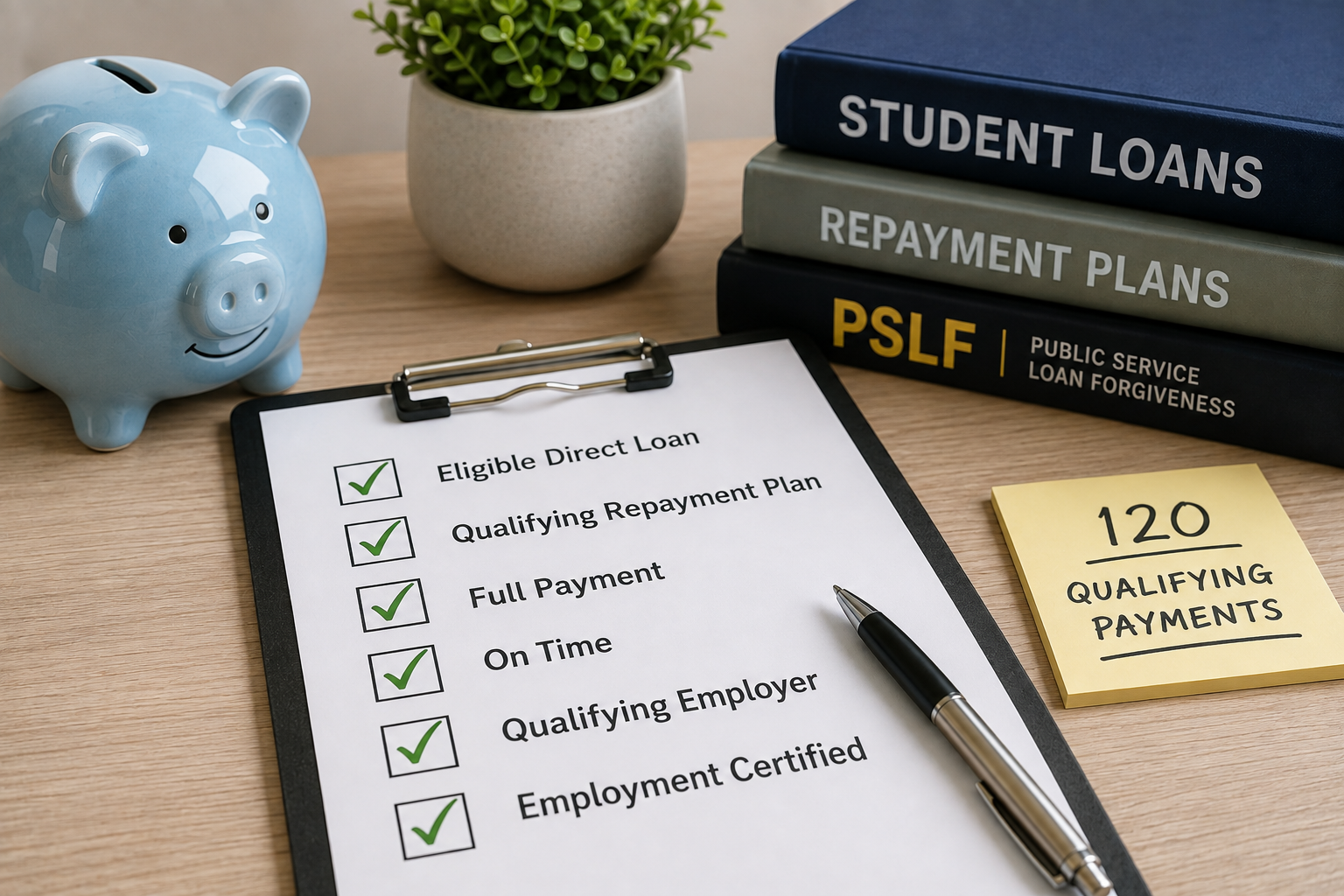
Public Service Loan Forgiveness is, at its heart, a counting program. One hundred and twenty qualifying payments, made while working full time for a qualifying employer. Get to 120, and the balance goes away.
The catch is that “qualifying” carries a lot of weight, and the definition has moved more than once in the last few years. Most of the borrowers who lose ground on PSLF don’t lose it dramatically. They lose it a month at a time, to small mechanical things nobody warned them about.
Here’s the current picture, and the handful of habits that protect you.
This article is general information, not legal or financial advice for your particular situation. Federal student loan policy is moving quickly; the details here are accurate as of August 18, 2026.
What a qualifying payment requires today
A month counts toward your 120 when all of these are true:- The payment is on an eligible Direct Loan. FFEL and Perkins loans have to be consolidated into a Direct Consolidation Loan first, and months before that consolidation is disbursed don’t count.
- You’re on a qualifying repayment plan — an income-driven plan (including the new Repayment Assistance Plan) or the 10-year Standard plan. Notably, the new Tiered Standard Plan does not qualify, which matters a great deal if you were auto-enrolled into it coming off SAVE.
- You paid the full scheduled amount due.
- The payment arrived on time — on or before that month’s due date, and after the prior month’s due date.
- You were employed full time by a qualifying employer during that month, and that employment gets certified.
About that 15-day window
For years, PSLF guidance included a cushion — a payment made within 15 days of the due date still counted. A lot of borrowers built habits around it, and a lot of articles still describe it. Don’t rely on it. The 15-day allowance is not part of the current requirements. The Department’s current PSLF application defines an eligible payment as one made in full and on time, meaning received on or after your most recent due date and before the due date of the current month. There’s no grace built into that language. Two honest caveats, because we’d rather you hear them from us: First, this has been a genuinely confusing area. Older federal materials on the topic are still floating around online, and you may find a page that still mentions 15 days. It’s stale. Go by the current application language. Second, there’s some ambiguity in how broadly the on-time requirement is being applied across every repayment plan versus the newer RAP rules specifically. We’re watching it closely. But the safe posture is identical either way: pay in full, pay on or before the due date, every month. Nobody has ever been harmed by paying on time.The small things that quietly cost people months
Auto-debit timing. Autopay protects you from forgetting, but check which day of the month the withdrawal actually posts. A withdrawal scheduled for the due date itself can land a day late when the date falls on a weekend or a federal holiday. Moving it a few days earlier costs you nothing and removes the risk entirely. Paying “a little extra, a little late.” Overpaying does not buy you forgiveness for a late arrival. The test is timing and full amount, separately. Prepaying without understanding the limits. You can pay ahead — a lump sum paid in advance of the due date can be credited across future months, generally up to about twelve. But prepaying doesn’t waive the employment side. You still need certified qualifying employment for each of those months. Letting certification lapse. Certify your employment regularly rather than saving it all for the end. Each approved certification is a piece of documentation, and documentation is what wins disputes later.If you’re coming off SAVE, read this twice
Months spent in the SAVE administrative forbearance do not count toward PSLF. That’s true even though you were told no payment was due. The remedy is PSLF Buyback, which lets borrowers with 120 months of certified qualifying employment pay a lump sum to convert certain forbearance and deferment months into qualifying payments. It’s a real path, and for some people it’s the difference between forgiveness and several more years of payments. It is not, however, a fast path. Tens of thousands of buyback requests have been pending, and processing has commonly stretched past a year. There have also been changes to how buyback amounts are calculated that have made the price meaningfully higher for some borrowers than it would have been in 2025. If buyback is part of your plan, get in the queue rather than waiting for the queue to shorten.One piece of good news
A rule finalized in late 2025 would have let the Department disqualify certain employers from PSLF eligibility based on their activities. It was scheduled to take effect July 1, 2026 — and a federal court vacated it the day before, nationwide. The Department has since removed the related attestation from the PSLF form. The practical upshot: no employer lost PSLF eligibility under that rule. If you put off certifying employment because you were worried about it, you don’t need to be.If your count changes, don’t just watch it
PSLF counts have been unstable this summer, and some borrowers have seen months disappear. We’ve written separately about what’s behind that and what to do. The short version applies here too: screenshot your count now. Download your payment history from both StudentAid.gov and your servicer. Keep every approved employment certification. If the number moves, you’ll be arguing from records instead of memory. And send it to us. We’d rather review a count that turns out to be fine than reconstruct one six months after it dropped. Working toward PSLF? Send us your current count and latest certification and we’ll make sure the months you’ve earned are the months you’re credited with.This article is general information, not legal or financial advice for your particular situation. Federal student loan policy is moving quickly; the details here are accurate as of August 18, 2026.
Recent Posts
tslhg-admin
Your Forgiveness Count Changed

tslhg-admin
PSLF Payment Rules
tslhg-admin
